
Meet Alex
Alex is someone whose story highlights the importance of communication in all its forms. Born with autism and living with epilepsy, she’s spent her life finding ways to connect with the world around her. But instead of relying solely on speech, Alex uses Augmentative and Alternative Communication (AAC) methods like Makaton symbols and a Grid Pad device to help express herself. These tools are more than just communication aids; they are her bridge to independence, work, friendships, and everyday life. In her journey with AAC, Alex has encountered challenges, but she has also experienced immense personal growth. Her reliance on Makaton symbols and technology has allowed her to flourish in a way that goes beyond typical communication. From waking up surrounded by symbols in her home to thriving in a supportive work environment, Alex shows that communication is about more than words – it’s about connection. Here’s a glimpse into her life, in her own words. Alex: My day starts with symbols, literally! I wake up, and my whole home is covered in Makaton symbols – from my kitchen cupboards to my weekly planner. They remind me of my routine: breakfast, work tasks, walking my dog, and even things like dusting. As I have epilepsy and autism, my brain sometimes needs visual cues to keep me on track, especially after a seizure. These symbols help me stick to a routine, which is really important for me. Despite using these tools, I live a pretty regular life – working, seeing friends, and even going out dancing sometimes! Alex: I didn’t start speaking until I was eight years old, so AAC has been a huge part of my life. I started with Makaton, which uses signs and symbols, and it was a real game-changer for me. Before that, I would express myself through behaviours, which could be frustrating. With Makaton, I could finally say what I was feeling, whether I was in pain or happy, and it made my world a lot clearer. Later, as technology advanced, I began using devices like talking buttons and voice output aids. Now, I use the Grid Pad 10s, which is essential for me after a seizure when I can’t speak. It’s linked to my phone, so I can even make calls using symbols. Alex: Before I had the Grid Pad, I used to feel like I was fading into the background, especially when I couldn’t speak after a seizure. I’d panic in situations where I couldn’t communicate. But now, my device gives me a voice. It’s not just about making things easier – it’s about making things possible. It’s given me so much confidence and independence. There’s something empowering about being able to express myself on my terms, even if I can’t physically speak. Alex: Yes, definitely. When I was younger, the technology wasn’t great. The devices were big, clunky, and not portable, so I didn’t always have access to them. Socially, it was also tough. People would sometimes assume I wasn’t intelligent just because I used symbols to communicate. They’d talk to whoever I was with instead of talking to me directly, which was hurtful. Even now, I sometimes feel shy about initiating conversations with new people. But things are improving. More people understand and accept AAC these days, and media representations, like Stephen Hawking, have shown the world that communication and intelligence aren’t defined by speech. Alex: I want people to know that communication comes in many forms. For me, it’s Makaton and my Grid Pad 10s, but for others, it might be something different. It’s not about the method; it’s about connecting with the world around you. Whether I’m sharing a joke with a friend, navigating a dating app, or giving input in a work meeting, AAC gives me the freedom to express myself fully. Honestly, I’m just like anyone else – living my life, laughing, learning, and embracing all the little moments. Alex: Growing up, in my late teens and early 20s, speech therapists helped me work on my speech through poetry and rhymes. They encouraged me to write about my experiences with autism and communication, and one of my favourite poems reflects how I felt when I didn’t have a voice – whether because there was no one to sign with or people didn’t understand my symbols. Here’s that poem: by Alex Hey you, please look at me, I try and jump, but I’m not tall, My arm is up, I wave to you, Hey you, please look at me, I stamp and bang the door, My eyes are wide and I stare, Hey you, please look at me, I start to cry and shout, My heart is racing so very quick. Hey you, please look at me, I’m trying to communicate, I would talk with my voice if I could, Hey you, please look at me, 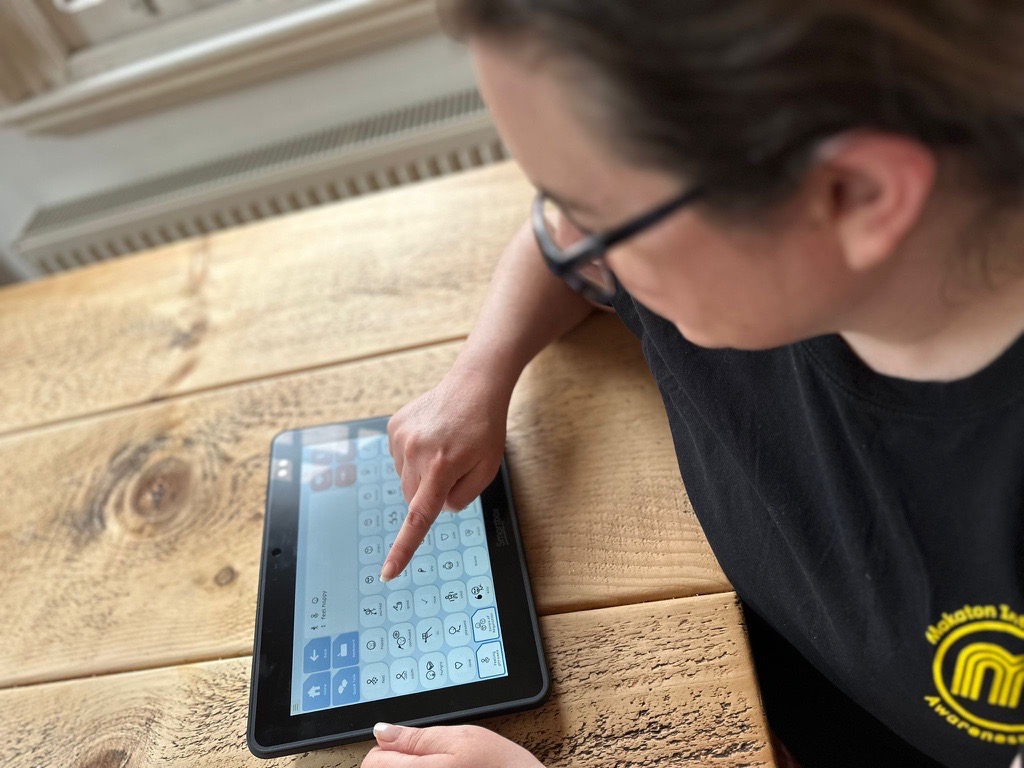
Q: Can you describe a typical day in your life and how AAC plays a role in it?
Q: How did you first start using AAC?
Q: How has using AAC affected your confidence?
Q: Have you faced any challenges using AAC?
Q: What would you like people to know about living with AAC?
Q: Is there anything else you’d like to add?
“Hey You, Please Look at Me”
Look at me, look at me I plea.
You just rush off down the hall.
But, you just don’t have a clue.
Look at me, look at me I plea.
You just walk across the floor.
You just look elsewhere.
Look at me, look at me I plea.
You tell them I’m acting out.
You turn your back, I feel sick.
Look at me, look at me I plea.
Look at me and concentrate.
You’re taking away my childhood!
Look at me, look at me I plea.